
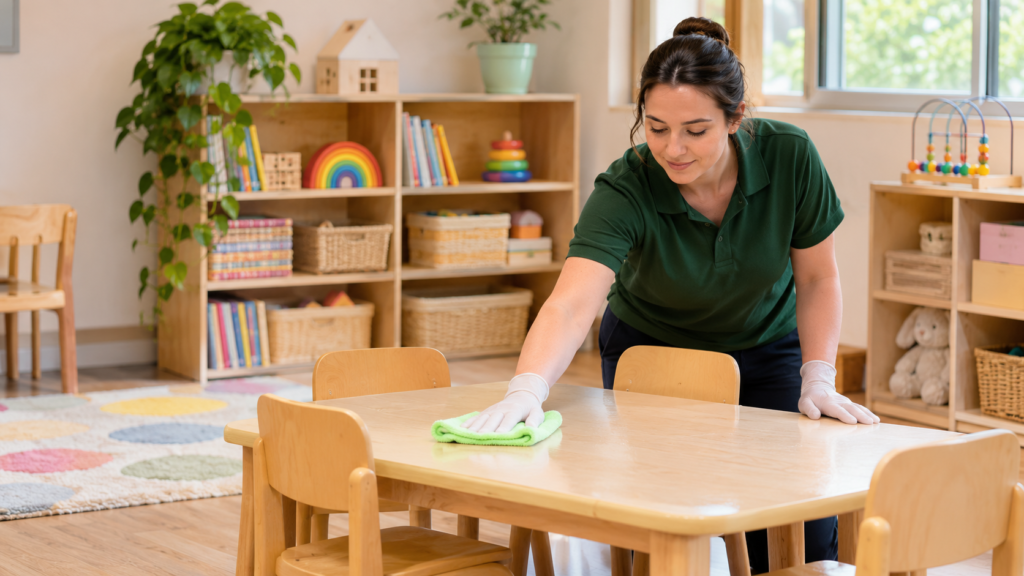
A childcare centre has different cleaning needs from a typical office. Children use tables, toys, washrooms, sleep areas and shared equipment throughout the day. Small spills can happen often, and some surfaces may be touched or mouthed by young children. A useful cleaning plan needs to fit the centre’s routines, approved products and room-by-room use.
In Saskatoon, snow, salt and spring mud can affect entrances and floors, so the cleaning schedule may need seasonal adjustments.
This guide outlines practical considerations for childcare centre cleaning in Saskatoon. It is general information, not a substitute for a centre’s own policies or provincial requirements. Each centre should follow its established procedures and the directions for the products it uses.
Start with the centre’s routines
Before setting a cleaning schedule, list the rooms and how they are used. A room for meals may need a different plan from a reading corner or staff office. Consider arrival and pick-up times, nap periods, meal preparation, washroom routines, and when staff can provide access to rooms.
Ask which rooms and surfaces are included, which tasks staff handle during the day, what equipment is staff-only, which products are approved, and when a cleaner can work without interrupting the centre.
A clear division of responsibilities reduces missed tasks and avoids duplicate work. A commercial cleaner can work to an agreed scope while the centre continues to manage the procedures assigned to its staff.
Use the centre’s procedures as your guide
The Saskatchewan Child Care Licensee’s Manual includes guidance about maintaining equipment and furnishings in sanitary condition, along with examples of cleaning and sanitizing routines. Centre operators should use their current procedures to decide what applies to their rooms and equipment. The cleaner’s written scope should reflect those instructions and the tasks assigned to the cleaning provider.
Give each room a practical task list
A room-by-room checklist makes a plan easier to follow. In activity rooms, commonly requested tasks may include emptying garbage, cleaning floors and wiping agreed surfaces such as tables, counters or door handles. Staff may have separate procedures for toys, learning materials and children’s personal items, so discuss those responsibilities before service begins.
In eating areas, clarify which surfaces belong to the cleaning scope and which are managed under the centre’s food-handling routines. For washrooms, the scope may include sinks, toilets, mirrors, floors and touchpoints, with separate cloths or tools used according to the agreed procedure.
Entrances and hallways often need attention because dirt and moisture travel indoors on footwear. A schedule might include floor care, visible spot cleaning and entrance glass, with more frequent attention during wet or snowy weather. Storage areas, staff rooms and offices should also be named so everyone knows whether they are included.
Coordinate high-touch surface cleaning
Door handles, light switches, taps, railings and shared tables can be touched repeatedly during a day. A centre’s own schedule can identify which surfaces staff handle during operating hours and which are included in after-hours cleaning.
Cleaning and disinfecting are separate tasks, and not every surface needs the same treatment each time. The product label and the centre’s procedures should guide which product is used, where it can be used, how long it must remain wet, and whether a rinse is needed. The Public Health Agency of Canada’s cleaning and disinfecting guidance also advises following product directions, including contact time.
For products represented for use on objects or surfaces young children may touch, Health Canada’s biocide labelling guidance discusses rinse recommendations after the labelled contact time to remove potential residues. Follow the specific product label and the centre’s procedures rather than assuming every product is used in the same way.
Keep product use and storage clear
Before work begins, agree on which products are permitted at the centre. The product list should match the centre’s requirements and the surfaces being cleaned. Confirm who supplies and stores the products, and how staff will be informed if a product or procedure changes.
Products should be used as directed on their labels. That includes dilution instructions, ventilation, contact time, surface compatibility and any rinse directions. Products should be secured and kept away from children, and different products should not be mixed unless their labels specifically say they can be used together. Health Canada advises reading and following product-label directions and keeping biocides and other chemical products out of children’s reach.
A professional cleaning plan should document the products and tasks agreed with the centre. If the centre requires a particular product or provides its own supplies, confirm that before the first visit.
Build the schedule around real use
A schedule should be realistic for the centre’s size, number of rooms, floor types and agreed scope. Some tasks may be done by staff during the day, while broader floor and room cleaning may be scheduled after children have left. A simple plan can group work into three levels: centre-led spill response and daily tasks; routine cleaning visits for agreed floors, washrooms, entrances and shared areas; and periodic tasks such as detailed edge cleaning or interior glass.
The exact frequency depends on the centre’s operation, traffic and priorities. A walkthrough helps identify the rooms, surfaces and access times involved before a quote is prepared. In Saskatoon, snow, slush and road salt may call for extra entrance attention in winter, while spring mud can increase floor soiling. A flexible checklist can reflect seasonal changes without making every scheduled visit identical.
Protect nap and activity areas from disruption
Cleaning should fit the centre’s daily flow. Ask about nap times, scheduled activities and room transitions before agreeing on service hours. If work takes place after hours, confirm how the cleaner will access the building, which alarms or locks are involved, and who to contact if a room cannot be entered.
The scope should also describe what happens when a room is being used, an item has been moved, or a surface needs special care. Fragile learning materials, personal belongings, bedding and children’s individual items should have clear handling instructions. A cleaning team should not have to guess whether to move or clean items the centre considers staff-managed.
Keep communication simple
A short service record can note the visit date, areas completed, access issues, supply concerns or maintenance observations. It supports communication about the contracted cleaning work and does not replace the centre’s internal records.
Choose one primary contact for schedule changes, special requests and feedback. If a room is closed or an event changes access, notifying the cleaning company ahead of time can help avoid missed work or wasted visits.
Review the checklist after the first few visits and adjust unclear tasks or frequencies by agreement.
What to discuss before hiring a cleaner
When comparing cleaning providers, ask them to explain their proposed scope in plain language. The quote should identify the rooms included, agreed tasks, frequency, service hours, product expectations and any exclusions. It should also explain how the provider handles access, feedback and requested changes.
A walkthrough is often the best way to understand the site. It allows the centre to point out floor types, busy areas, storage expectations and any surfaces that require special instructions. It also gives the provider a better basis for estimating time and preparing a useful checklist.
Two centres with a similar floor area can have different layouts, schedules and responsibilities, so a walkthrough helps shape a site-specific plan.
Request a childcare-centre cleaning walkthrough in Saskatoon
A well-organized cleaning plan begins with listening to how the centre operates. When the cleaning company and centre agree on room access, tasks, approved products and communication, it becomes easier to keep the service consistent and adjust it when routines change.
365 Commercial Cleaning Services Ltd. provides commercial cleaning in Saskatoon. If your childcare centre is reviewing its cleaning arrangements, learn about our commercial cleaning services or request a quote or walkthrough. Share the rooms, preferred schedule and tasks you would like included, and we can review the site and prepare a scope for your consideration.
Pingback: Commercial Cleaning Guide For Businesses | 7 Best Tips