
A clear commercial cleaning contract checklist covers the work and its frequency, service schedule, payment terms, insurance responsibilities, site access, quality reviews, and how changes or termination are handled. The scope of work adds the practical detail: which areas are cleaned, what tasks are included, and when they happen.
A contract should prevent misunderstandings, but broad phrases such as “general cleaning” can leave important duties open to interpretation. Specific terms help both parties understand what will be done, how service concerns are handled, and which details belong in the contract versus the scope of work.
This guide explains what to include, how to distinguish the contract from the scope, and which insurance, terms, and onboarding details deserve attention. Use it to organize the decisions before cleaning begins and set up a working arrangement that supports a clean, well-presented facility.
Key Takeaways
- Separate the contract’s service terms from the scope of work, which spells out the tasks, areas, and cleaning frequency.
- Make the agreement clear about its term, renewal approach, notice period, and how either party can end it.
- Set out insurance responsibilities and practical onboarding details, including site access, contacts, and facility requirements.
- Define how work quality will be reviewed and how cleaning issues, follow-up, and agreed standards will be documented.
What is the difference between a cleaning contract and a scope of work?
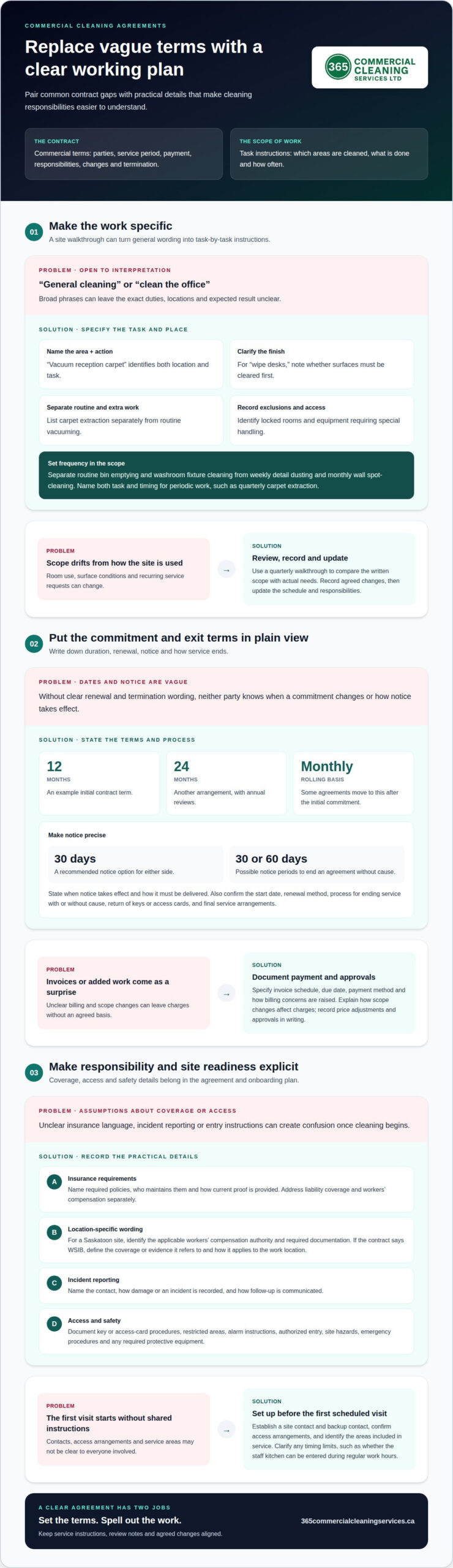
A cleaning contract sets out the commercial terms: the parties, service period, payment, responsibilities, changes, and termination. The scope of work translates those terms into task instructions for each area. Keeping the two distinct prevents broad wording, such as “clean the office,” from standing in for a complete service description.
A site walkthrough helps define the scope before work begins. Map rooms and surfaces, note access restrictions, and identify high-use areas such as reception desks, washrooms, and staff kitchens. Record surface types and priority concerns, such as fingerprints on interior glass or spills near a coffee station. This connects each task to a specific location and expected result.
- Name each area and task: “Vacuum reception carpet” identifies both the location and action.
- Describe the finish: “Wipe desks” can clarify whether surfaces must be cleared first.
- Separate included work: List carpet extraction apart from routine vacuuming.
- Record exclusions and access: Identify locked rooms or equipment that requires special handling.
Set task frequency in the scope rather than relying on vague wording. List routine duties, such as emptying bins and cleaning washroom fixtures, separately from weekly detail dusting or monthly wall spot-cleaning. For periodic work, name both the task and timing, such as quarterly carpet extraction. This makes office cleaning easier to schedule and provides a shared reference when priorities change.
Set a review step, too. A quarterly walkthrough can compare the written scope with actual room use, surface conditions, and recurring service requests. Record any agreed change in the scope, then update the schedule and responsibilities so instructions stay aligned. Health and environmental standards can also guide specifications: the International Organization for Standardization identifies ISO 45001 as an occupational health and safety certification and ISO 14001 as an environmental management certification. If a contract references either, define the relevant expectation rather than relying on an acronym alone.
Contract terms, notice periods, and termination
Write the agreement so its duration, renewal, payment, and exit terms are easy to find. A standard office-cleaning contract may start with a 12-month term; 24 months with annual reviews is another typical arrangement. Some agreements move to a rolling monthly basis after the initial commitment, which gives both parties a regular point to reassess service.
Notice periods need equally clear wording. A 30-day notice period for either side is a recommended option, while contracts may set 30 or 60 days to end the agreement without cause. State when notice takes effect and how it must be delivered, so neither party has to interpret a vague phrase such as “reasonable notice.”
- Confirm the initial term and start date. Clear dates establish when service and payment responsibilities begin.
- Define renewal steps. State whether the agreement renews automatically or requires written approval, and when renewal terms are reviewed.
- Set notice and termination terms. Identify the notice period, delivery method, and process for ending service with or without cause.
- Describe the exit process. Clarify when keys, access cards, or site materials are returned, and how final service is handled.
Set payment terms that support predictable cash flow. Specify the invoice schedule, due date, accepted payment method, and process for raising a billing concern. Explain how changes to the cleaning scope affect charges, and separate potential additional work, such as requested carpet extraction, from regular service. This helps prevent unexpected charges without an agreed basis.
Record how price adjustments are proposed and approved, including when they take effect. Keep every change in writing, with the updated service or payment terms attached to the agreement. If you’re defining recurring service needs, explore commercial cleaning services while clarifying the schedule and responsibilities.
Insurance requirements and onboarding
Insurance terms should explain what coverage applies during cleaning and how incidents are handled. Name the required policies, who maintains them, and how current proof is provided. Address liability coverage and workers’ compensation separately, since one is not a substitute for the other. For a Saskatoon site, identify the applicable workers’ compensation authority and the documentation the agreement requires.
WSIB is a specific name, not a generic term for workers’ compensation. If it appears in contract language, define the coverage or evidence it refers to and explain how it applies to the work location. This helps prevent confusion when a business operates across provincial boundaries. The agreement can also specify how updated insurance documents are shared during the service relationship.
- List insurance requirements: Identify the policies, proof of coverage, and responsibility for keeping documents current.
- Set a damage-reporting process: Name the contact, how an incident is recorded, and how follow-up is communicated.
- Document site access: Record key or access-card procedures, restricted areas, alarm instructions, and who can authorize entry.
- Set safety expectations: Include site-specific hazards, emergency procedures, and any required protective equipment.
Onboarding turns these terms into clear working instructions. Before the first scheduled visit, establish a site contact, a backup contact, access arrangements, and the areas included in service. For example, specify whether a staff kitchen can be entered during regular work hours or only when unoccupied. Note where supplies are stored and how spills or blocked access are reported.
Set a communication routine that suits the site, such as a weekly update about access changes or unresolved concerns. Record who receives updates and how urgent issues are escalated. A written handover helps cleaning staff follow consistent instructions, protect sensitive areas, and understand the facility’s safety procedures. These details support clear coordination and make coverage and liability responsibilities easier to manage.
What should be included in a commercial cleaning contract?
A commercial cleaning contract checklist should record the provider’s relevant experience, staff training, communication process, and capacity to deliver the agreed work. Identify who handles schedule changes and who receives service concerns, so updates reach the right contact. The International Organization for Standardization identifies ISO 9001 as a quality management certification. If the contract refers to it, describe the quality practices expected rather than treating the certification name as a service promise.
Clarify supplies and equipment before work begins. State which party provides cleaning products, tools, and consumables, where they are stored, and how replenishment is arranged. For example, the client might supply washroom paper products while the cleaning company provides its equipment. Naming each responsibility helps prevent gaps during routine service.
- Define staff preparation: Record site orientation, task instructions, and how changes are communicated.
- Specify quality standards: Describe observable results, such as clean washroom fixtures or a vacuumed carpet.
- Set inspection methods: Identify who reviews completed work, how often, and where findings are recorded.
- Document corrective action: Explain how a missed task is reported, assigned, and tracked to completion.
Measure service quality with documented inspections, clear task standards, and a shared issue log. State how complaints are recorded, who reviews them, and how corrective actions are tracked. A commercial cleaning contract checklist helps organize these measures, from recording a missed task to confirming its completion.
Before signing in Canada, look for vague task descriptions, unclear supply responsibilities, missing insurance terms, and no process for resolving service concerns. These gaps can leave responsibilities and follow-up open to interpretation.
For a facility-specific cleaning plan, discuss your commercial cleaning needs and the priorities the agreement should reflect.
365 Commercial Cleaning Services: Commercial Cleaning
365 Commercial Cleaning Services Ltd provides commercial cleaning in Saskatoon, with plans tailored to each facility and schedule. Turn to the team when you need regular cleaning aligned with your workplace priorities, or additional support for carpets, upholstery, windows, and storefronts.
Services include Commercial Cleaning, Carpet & Upholstery Cleaning, Deep Cleaning & Sanitization, and Window & Storefront Cleaning. A clear agreement can connect these needs to suitable tasks, service frequency, site access details, and quality checks, so expectations are practical from the start.
Share your facility’s cleaning priorities and scheduling needs with 365 Commercial Cleaning Services Ltd to discuss the next step.
Put the Agreement into Practice
A signed agreement can guide decisions beyond the initial setup. Use it when planning facility changes so the cleaning arrangement stays aligned with how the space is used. A commercial cleaning contract checklist can keep those conversations organized around your workplace’s priorities.
For Saskatoon workplaces, 365 Commercial Cleaning Services Ltd can discuss how a cleaning plan may fit your facility and operating needs. A practical starting point is to identify the areas that need attention and the outcomes that matter most to your team.
Contact 365 Commercial Cleaning Services Ltd to discuss your facility’s cleaning needs. A considered next step can help you move forward with confidence.
Frequently Asked Questions
Can I change the scope after signing?
The parties can agree to adjust the work when facility needs change. A new tenant, renovation, or shift in staff use may affect which spaces need attention. Before changing routines, identify the affected areas and consider how the change interacts with existing schedules and site access. This keeps service practical as the workplace evolves.
Need insurance before you bid?
Insurance requirements can vary by bid, so review the tender documents before deciding what evidence to submit. A property manager may request proof with the bid, while another may ask for it before work starts. Note the requested policy types, limits, and submission timing, then make sure the proposal responds to those requirements without implying broader coverage.
What SLA metrics should your cleaning contract require?
Choose measures that reflect the facility’s priorities, then define exactly how each is calculated. For example, a completion rate needs a clear list of tasks included in its denominator, while an inspection score needs consistent criteria across rooms. Specify how client closures, restricted access, or cancelled visits are treated, so results reflect service performance rather than unrelated disruptions.
Who is responsible if a cleaner damages something?
Responsibility depends on the circumstances and the terms agreed by both parties. A practical safeguard is to document existing damage or fragile items before service begins, such as a cracked display case or loose cabinet handle. A dated condition record helps distinguish pre-existing wear from a new incident and gives both parties a useful reference during review.
What should a commercial cleaning contract include in Canada?
Use the agreement to identify each party’s correct legal name and the specific premises covered. For a multi-site business, list each address separately and state whether the same scope applies at every location. Identify who can approve operational changes for each party as well. These details reduce confusion when managers, billing contacts, or site requirements differ.
Which cleaning tasks and service areas should be specified in the scope of work?
Describe boundaries as well as tasks. For example, distinguish a staff kitchenette from a public lunch area, and state whether desk surfaces, shared appliances, or equipment interiors are included. A floor plan marked by room use can identify included and restricted spaces. Note seasonal or occasional areas, such as an entry vestibule where foot traffic changes.