
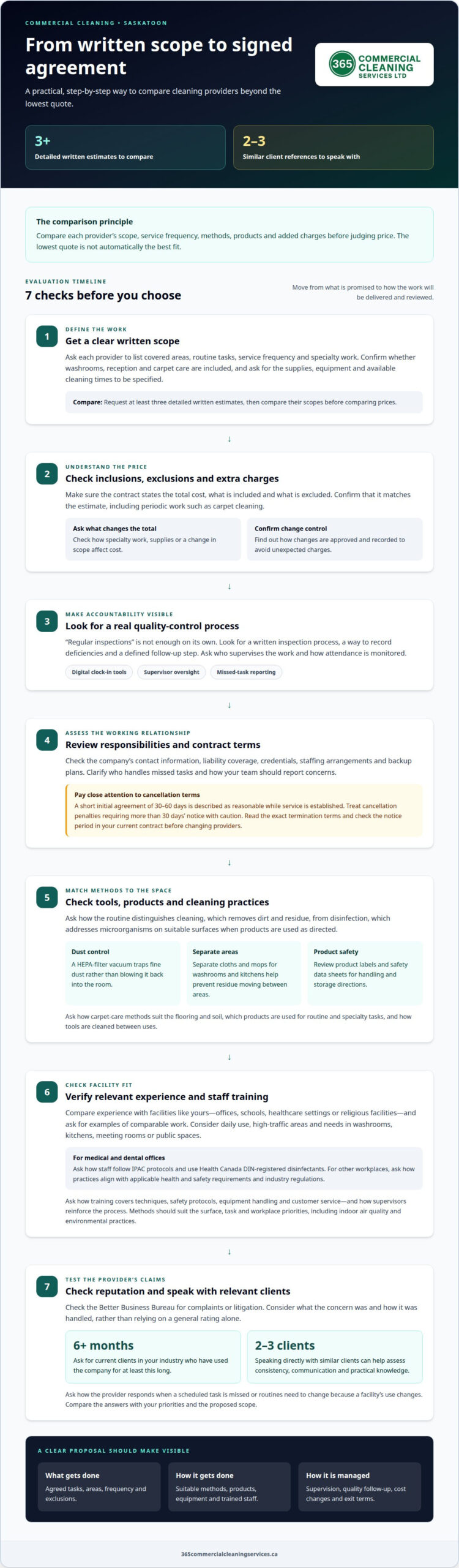
The lowest quote isn’t automatically the best fit. When choosing a commercial cleaning company, compare detailed written estimates from at least three contractors. Look beyond the price to the tasks included, cleaning frequency, products and equipment, and any additional charges. A clear scope shows what each proposal covers.
A clean, presentable workplace shouldn’t create extra work for your team. Compare providers on consistency, suitable cleaning methods, and whether the proposed plan fits your facility’s use and schedule.
This guide explains how to assess contract terms, cleaning methods, relevant experience, reputation, and client references. Use these practical criteria to compare options for your Saskatoon workplace.
Key Takeaways
- Compare written scopes, service frequency, inclusions, exclusions and added charges so you can judge proposals on more than price.
- Look for cleaning methods, equipment and products suited to your facility’s needs, including whether eco-friendly options matter to your workplace.
- Assess experience with facilities like yours and consider how the company’s reputation reflects its consistency and service quality.
- Use relevant client references to understand reliability, staff training, insurance and background-check practices before deciding.
1. Reviewing contract terms and additional fees
Start with a written scope. It should list the areas covered, routine tasks, service frequency, and any specialty work. Confirm whether washrooms, reception, and carpet care are included. Ask the provider to specify supplies, equipment, and available cleaning times. Request at least three detailed estimates, then compare their scopes before comparing prices.
Check that the contract includes the company’s contact information, total cost, inclusions, and exclusions. Confirm that the listed work matches the estimate, including periodic tasks such as carpet cleaning. Identify who handles missed tasks and how to report concerns. A clear process saves your team from chasing work without knowing who is responsible.
Review possible additional charges alongside the regular service terms. The contract should explain whether specialty work, supplies, or changes to the scope affect the total cost. Ask how changes are approved and recorded to avoid unexpected charges. Also review liability coverage, credentials, staffing arrangements, and backup plans.
Quality control should be more than a promise of “regular inspections.” Look for a written inspection process, a way to record deficiencies, and a defined follow-up step. Ask who supervises the work and how attendance is monitored, including whether the company uses digital clock-in tools or supervisor oversight. These details show how service is tracked against the agreed scope.
Check the cancellation clause before signing. A short initial agreement of 30-60 days is described as reasonable while service is established. Treat cancellation penalties requiring more than 30 days’ notice with caution, and read the exact termination terms. If changing providers, review your current contract’s notice period before notifying the existing company. Choosing a commercial cleaning company is easier when responsibilities, service standards and exit terms are clear.
2. Assessing cleaning methods, equipment, and products
Cleaning methods should suit the surface and task. Office cleaning may cover desks, washrooms, shared kitchens, carpets, and high-touch areas. Cleaning removes dirt and residue; disinfection addresses microorganisms on suitable surfaces when products are used according to their directions. Ask how the routine distinguishes these tasks instead of treating every surface alike.
Equipment should match the job. A HEPA-filter vacuum traps fine dust rather than blowing it back into the room, while carpet care requires methods suited to the flooring and soil. Separate cloths and mops for washrooms and kitchens help prevent residue from being carried between areas. Ask which tools are assigned to each space and how they are cleaned between uses.
Cleaning products affect employees and the workplace environment. Ask which products are used for routine cleaning and which for specialty tasks. Review labels and safety data sheets for handling and storage directions. Eco-friendly products can support a green cleaning approach, but methods must still suit the surface and cleaning objective.
Training helps ensure tools and methods are used consistently. Cleaning staff should understand techniques, safety protocols, equipment handling, and customer service. For example, staff need to know how to clean carpet without using an unsuitable method. Ask how training covers these areas and how supervisors reinforce the process.
Compare the provider’s equipment and product choices against your facility’s priorities, including indoor air quality, surface care, and environmental practices. Commercial cleaning services can also use steam cleaning methods and eco-friendly products without harsh chemicals. If those choices suit your workplace, explore an eco-friendly cleaning approach as part of your service plan.
3. Experience, reputation, and industry-specific expertise
Experience with a similar facility can show whether a cleaning plan will suit your workplace. Offices, schools, healthcare settings, and religious facilities each have different cleaning needs. Compare a company’s experience with your building type, daily use, and high-traffic areas. A provider familiar with busy reception areas may understand presentation needs, while a school requires attention to shared spaces and varied surfaces.
Ask for examples of comparable work, not just a general claim of commercial experience. Consider how the provider adapts janitorial tasks for washrooms, kitchens, meeting rooms, or public areas. A useful discussion explains which needs differ between facilities and how those differences affect the scope and cost. Relevant experience can make expectations more practical from the outset.
Some industries have distinct procedures and product requirements. Medical and dental offices need cleaning staff who follow IPAC protocols and use Health Canada DIN-registered disinfectants. Other workplaces should align cleaning practices with applicable health and safety requirements and industry regulations. Ask how staff training and products address your facility’s needs rather than assuming one method suits every setting.
Reputation offers another perspective. Businesses researching a commercial cleaning contractor can check the Better Business Bureau for complaints or litigation. Consider the nature of any concern and how it was handled, rather than relying on a general rating alone. Ask for references from current clients in your industry who have used the company for at least six months. Speaking directly with two to three similar clients can help you assess consistency, communication, and practical knowledge.
Use reference conversations to test specific claims. Ask how the provider responds when a scheduled task is missed or adapts routines when a facility’s use changes. Compare the answers with your workplace priorities and the proposed scope. This gives you a clearer basis for assessing experience, reputation, and fit.
4. How do I verify a cleaning company’s references in Saskatoon?
For a Saskatoon workplace, request references from businesses with similar facilities and cleaning needs. Speak directly with two to three current clients who have used the company for at least six months. Ask about punctuality, communication, consistency, and how the team handled a missed task. A reference from a similar facility can reveal more than a general testimonial.
What services should a commercial cleaning company provide? The right scope depends on the facility and may include routine janitorial cleaning, washroom care, carpet and upholstery cleaning, deep cleaning, and window or storefront cleaning. Choose services for your actual spaces and priorities. A retail store may prioritize clear entry glass, while an office may need regular attention to shared areas.
Ask how cleaning tasks are documented and followed up. A checklist can link each task to a specific area, such as wiping meeting-room tables or cleaning glass entry doors. Find out how staff record completed work and how a supervisor follows up on missed items. This makes it easier to assess service over time.
Review the company’s liability insurance certificate to understand coverage for property damage and bodily injury claims. Ask whether cleaning staff are insured and background-checked, and how training covers equipment, safety procedures, and customer service. Credentials should relate to the work and your facility’s needs. For medical or dental settings, confirm that staff follow IPAC protocols and use Health Canada DIN-registered disinfectants.
Online reviews can add context to reference conversations. Check the Better Business Bureau for complaints or litigation and Indeed for comments from current or former employees. Look for recurring themes around communication, staffing, or service consistency. Compare them with the company’s checklist and feedback from references.
Use these steps to assess whether a cleaning process fits your facility. Discuss a cleaning plan for your workplace that reflects its spaces and priorities.
365 Commercial Cleaning Services: Commercial Cleaning
365 Commercial Cleaning Services Ltd can help when your workplace needs a cleaning plan suited to its spaces and schedule. Its commercial cleaning is tailored to each facility, supporting consistent care without treating every workplace the same.
Choose services to match your priorities: routine commercial cleaning for shared areas, carpet and upholstery cleaning for fabric surfaces, deep cleaning and sanitization for more thorough care, or window and storefront cleaning to maintain a clear presentation. Each service addresses different needs across your facility.
If you’re comparing cleaning methods and references, discuss the areas you want covered and the schedule that fits your operations. Contact 365 Commercial Cleaning Services Ltd to talk through your commercial cleaning needs.
Set a cleaning plan that fits your workplace
The value of choosing a commercial cleaning company lies in finding an arrangement that supports your facility’s daily operations. Use your priorities to guide the discussion: which areas need routine attention, where a deeper clean would help, and what schedule fits how your team uses the space.
365 Commercial Cleaning Services Ltd offers commercial cleaning, carpet and upholstery cleaning, and deep cleaning and sanitization. These options can help address routine workplace care alongside specific surface or cleaning needs. A practical plan starts with the spaces you want maintained and the outcomes that matter to your business.
Share your facility’s priorities and discuss a suitable cleaning plan with 365 Commercial Cleaning Services Ltd. A clear conversation is a useful first step towards a workplace that feels cared for and ready for the day ahead.
Frequently Asked Questions
What should I look for in a commercial cleaning company?
Choose a provider whose plan fits your workplace’s daily operations. Consider how staff will access the building, protect sensitive areas, and follow instructions for rooms with restricted entry. A clinic, for example, may need clear guidance on which rooms are ready for cleaning. These practical details should be part of the working arrangement from the outset.
How do I verify a cleaning company’s references in Saskatoon?
When comparing Saskatoon cleaning services, seek references from businesses with similar facilities and needs. Ask how the company communicates when priorities change and whether its team understands the client’s operations. A retail manager, for example, can explain how cleaning is coordinated around customer-facing areas. Look for specific examples of day-to-day service, not broad praise alone.
How much does commercial cleaning cost in Saskatoon?
The cost of commercial cleaning in Saskatoon depends on the size and layout of your facility, its current condition, how often it needs cleaning, and the services you require. For example, an office that needs routine cleaning several times a week may have different needs from a facility requesting a one-time deep clean or post-construction cleaning. The quote may also depend on areas such as washrooms, kitchens, carpets, and shared spaces. 365 Commercial Cleaning Services can prepare a quote based on your workplace and cleaning priorities. Contact us with a few details about your facility to request an estimate
How often should I hire a commercial cleaning service?
Set cleaning frequency according to your facility’s size, occupancy, foot traffic, operating hours, and use. A busy entrance or shared washroom may need more regular attention than an occasional-use meeting room. Review the schedule when staffing, customer traffic, or room use changes. The goal is a routine that meets actual needs without unnecessary visits.
Should I sign a long-term contract with a cleaning company?
Choose contract terms that give both sides a practical way to assess the arrangement. Before committing long term, understand renewal conditions, how changes to tasks are recorded, and what happens if your facility’s needs shift. A business moving teams between floors, for instance, may need a revised scope. Clear change and exit provisions help keep the agreement aligned with operations.
How do you compare commercial cleaning companies in Canada?
Compare proposals by mapping each provider’s tasks to the same areas, such as entrances, offices, washrooms, and shared kitchens. Then assess how each plan fits your operating hours, site requirements, and environmental preferences. Choosing a commercial cleaning company is a practical decision: the best fit is the documented approach that suits your workplace, not simply the shortest proposal.