
Staff screening and insurance are separate safeguards, so neither is established by the phrase commercial cleaning and janitorial services alone. In Saskatoon, costs depend on the facility, the tasks included, how often they’re done, and the schedule. A quote should clearly set out the scope and frequency.
It’s reasonable to want dependable people on site and a clear account of what a cleaning plan covers. When partnering with 365 Commercial Cleaning Services Ltd, this guide explains how to assess screening and insurance, what affects costs, and how to match service frequency to the way your workplace is used.
You’ll also find an overview of specialized options, including carpet and upholstery cleaning, deep cleaning and sanitization, and window and storefront cleaning. Use these practical details to decide what coverage fits your facility and plan its care.
Key Takeaways
- Build a clearer cleaning quote by defining the tasks and how often each one is needed; after-hours schedules can affect the cost.
- Match carpet, window and other specialized cleaning to the surfaces and conditions in your facility.
- Understand how disinfectant application to high-touch areas fits into a cleaning plan, and what to look for when reviewing staff screening and insurance.
- Choose a cleaning frequency around your workplace’s traffic, then explore tailored commercial cleaning and specialized services for your facility.
How much does commercial cleaning cost?
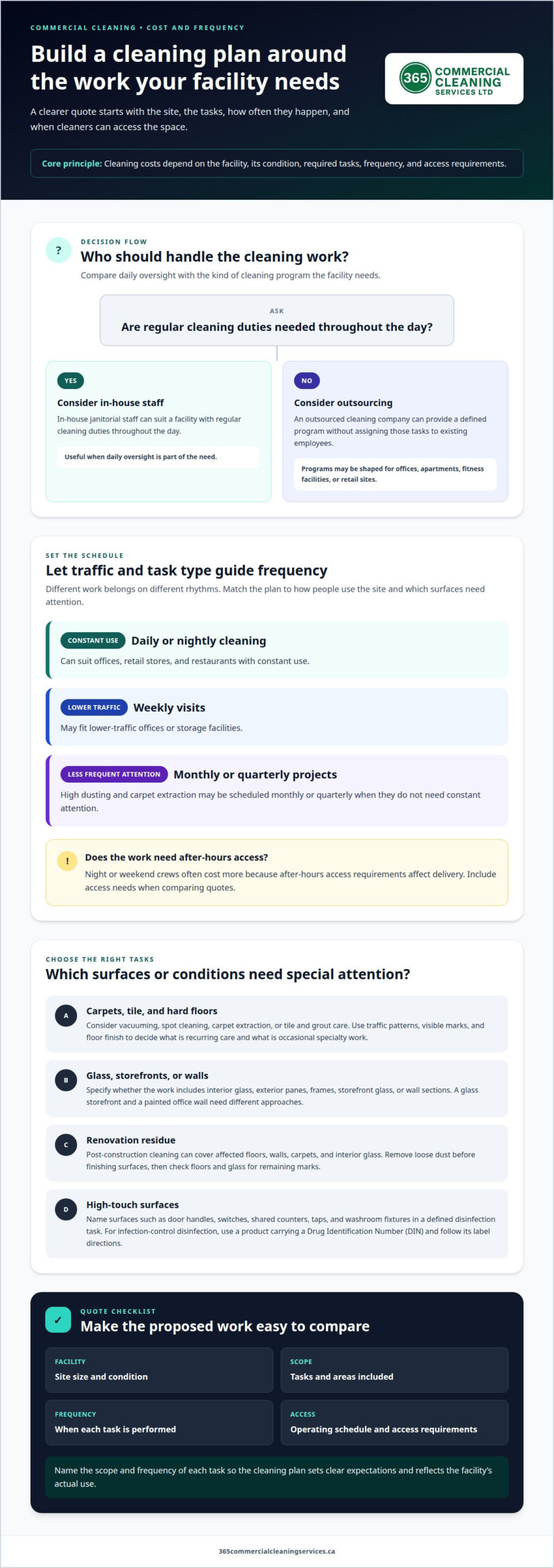
Commercial cleaning costs depend on the facility, its condition, the tasks required, and how often they’re scheduled. A clinic may need washroom and touchpoint cleaning, while a retail space may prioritize floors, entrances, and glass. In Saskatoon, the quote should reflect the site size, scope, frequency, and access requirements. Ask for each of these to be clearly set out so you can compare the proposed work with your needs.
Businesses choose between in-house janitorial staff and an outsourced cleaning company by weighing daily oversight against the work needed. In-house staff can suit a facility with regular cleaning duties throughout the day. Outsourcing can provide a defined cleaning program for offices, commercial buildings, fitness facilities, or retail sites without assigning those tasks to existing employees. Night or weekend crews often cost more because after-hours access requirements affect delivery.
Across Canada, commercial cleaning and janitorial services can include routine office cleaning, washroom care, floor cleaning, carpet extraction, window washing, and deep cleaning. Industrial cleaning programs may address production areas, shared floors, or other site-specific needs. The facility’s use determines which tasks belong in its schedule; an office, gym, school, and medical setting each has different surfaces and shared spaces.
A commercial cleaning plan should name the scope and frequency of each task. It can specify which areas receive floor care, washroom cleaning, and waste removal, then state when each task is performed. These details set clear expectations and align routine janitorial work with the facility’s operating schedule.
Start by grouping work into recurring tasks and less frequent projects. Daily or nightly cleaning can suit offices, retail stores, and restaurants with constant use; weekly visits may fit lower-traffic offices or storage facilities. High dusting and carpet extraction may be scheduled monthly or quarterly when they don’t need constant attention. A clear task list helps match the cleaning program to actual traffic and surfaces.
Carpet, window and post-construction cleaning
Specialized cleaning addresses surfaces that routine janitorial work may not fully cover. Carpet condition, window access, floor materials, and renovation residue all affect the work required.
Floor and Carpet Care
Floor and carpet care can include vacuuming, spot cleaning, carpet extraction, and tile and grout care. A carpeted reception area may need stain treatment, while hard floors need care suited to their finish. Check traffic patterns, visible marks, and the surfaces in each space to decide what belongs in recurring care and what is occasional specialty work.
Dust and grit tracked through an entrance can affect nearby carpets and floors. Include these transition areas, shared corridors, and meeting rooms in the cleaning scope so it reflects how people use the facility.
Window and Wall Cleaning
Window and storefront cleaning removes visible marks from glass in entrances and customer-facing spaces. Wall cleaning can address scuffs near doorways, corridors, and waiting areas. Specify the surface and condition: a glass storefront and a painted office wall need different approaches.
Include interior glass, exterior panes, frames, or wall sections according to the property’s needs. Clear boundaries distinguish routine cleaning from work focused on a specific buildup or area.
Post-construction Cleaning
Construction cleaning removes dust and residue after renovation work, before rooms return to everyday use. Depending on the affected spaces, the scope can include floors, walls, carpets, and interior glass. Reviewing each room helps distinguish construction debris from marks that need surface-specific care.
Tile and grout may need dedicated attention after renovation work, while carpeted areas may need vacuuming or spot treatment. The sequence matters: remove loose dust before finishing surfaces, then check floors and glass for remaining marks. This keeps the cleaning focused on renovation residue rather than repeating routine tasks.
For ongoing care of carpets, floors, and storefront glass, a commercial cleaning service can align these tasks with the facility’s needs. A defined scope also makes it easier to separate recurring maintenance from one-time construction cleanup.
Disinfectant application to high-touch areas
Cleaning arrangements and applicable requirements can differ by province, municipality, and facility type. Build the plan around the location, the space’s use, and the products involved.
Workplace safety planning includes the safe handling of hazardous cleaning products. Under WHMIS, employers have responsibilities that include making Safety Data Sheets accessible and training staff to handle hazardous products safely. Cleaners need access to product information and relevant handling instructions before using chemicals in an office, retail space, or washroom.
High-touch areas can include door handles, switches, shared counters, taps, and washroom fixtures. A clear disinfection plan identifies these surfaces and assigns them to a defined task. For infection-control disinfection, use a product carrying a Drug Identification Number (DIN). Follow the product label for its intended use and application directions, including the required attention to the treated surface.
Routine cleaning, sanitization, deep cleaning, and disinfection describe different parts of a facility’s care plan. Cleaning addresses visible soil and everyday upkeep; targeted disinfectant application focuses on selected surfaces. Deep cleaning can address accumulated soil across a wider area, while commercial tenant turnover cleaning may include vacant office or retail areas, washrooms, and frequently touched fittings. Define the work by room and surface.
For example, an office plan might include desks and shared touchpoints in routine office cleaning, with a separate task for washroom fixtures. A retail plan may focus on counters, payment areas, and door hardware. These examples clarify which surfaces receive attention and when, rather than treating every room and surface alike.
Disinfectant use depends on the product and the surface being treated. A written scope can name high-touch areas, the cleaning sequence, and the product directions staff follow. This helps keep disinfection consistent with the facility’s needs.
Commercial cleaning and janitorial services in Saskatoon
A useful cleaning plan reflects how a Saskatoon facility operates, including its traffic, surfaces, and access arrangements. A busy entrance may need different attention from an occasionally used meeting room, while shared washrooms need clearly assigned tasks.
When reviewing a cleaning proposal, look at the task list, visit schedule, staff training, insurance documentation, and process for addressing missed work. A thorough proposal explains what gets cleaned, how often, and which areas need specialized attention.
Staff screening and insurance are separate safeguards. Screening concerns who may enter the workplace; insurance relates to coverage for defined risks. Review the documentation for each separately. Staff should also understand site access, cleaning procedures, and relevant product-handling instructions.
Traffic patterns help determine a workable schedule. A Saskatoon retail entrance may collect soil throughout the day, while an office boardroom may see heavier use during meetings. Lower-use rooms have different priorities from shared spaces. Set the schedule around these differences instead of applying identical tasks everywhere.
A written agreement can separate recurring janitorial work from periodic carpet, floor, or window care. It should define the frequency for each task, making it easier to assess the work against the facility’s needs. Specific descriptions reduce ambiguity when staff or operating patterns change.
Before service begins, organize the plan around access, priority areas, and cleaning sequence. A shared office, for instance, can identify reception, washrooms, and meeting rooms as separate zones. This creates a practical routine that is easier to adjust when traffic shifts.
For a cleaning plan tailored to your facility and schedule, request a tailored cleaning plan.
365 Commercial Cleaning Services: Commercial Cleaning
365 Commercial Cleaning Services Ltd provides commercial cleaning plans tailored to each facility and schedule. Turn to the team when routine janitorial work needs a consistent scope, or when a space needs focused attention beyond regular cleaning.
Commercial cleaning supports everyday facility care, while Carpet & Upholstery Cleaning addresses soft surfaces and Deep Cleaning & Sanitization provides a more thorough clean. Window & Storefront Cleaning helps keep glass clear and presentable. Advanced steam cleaning methods and eco-friendly products that do not use harsh chemicals support the cleaning approach.
Share the facility’s priorities and preferred schedule to start a conversation about suitable cleaning support. Contact 365 Commercial Cleaning Services Ltd to discuss your commercial cleaning needs.
Set up a cleaning plan that fits your workplace
Turn your workplace priorities into a practical cleaning plan. Consider which spaces need regular attention, where specialized cleaning would help, and how the schedule can work around daily operations. Clear priorities make it easier to tailor commercial cleaning and janitorial services to your Saskatoon facility.
365 Commercial Cleaning Services provides Commercial Cleaning, Carpet & Upholstery Cleaning, and Deep Cleaning & Sanitization. Its cleaning plans are tailored to each facility and schedule, helping businesses address routine care and specific cleaning needs within one coordinated approach.
Share the facility’s priorities and preferred schedule to start a conversation about suitable cleaning support. Contact 365 Commercial Cleaning Services to discuss your workplace needs and take the next step towards a well-maintained space.
Frequently Asked Questions
Are staff screened and insured?
Screening and insurance address different concerns, so one does not establish the other. For a Saskatoon workplace, screening relates to who enters the facility, while insurance relates to covered incidents and liabilities. Consider them separately alongside access procedures and assigned cleaning tasks. A schedule or task list alone does not establish either safeguard.
Do you clean after hours and on weekends?
Cleaning plans can be tailored around a facility’s operating hours, but that doesn’t establish after-hours or weekend availability. For a Saskatoon workplace, include the preferred cleaning window and any access restrictions in the service plan. For example, a business may need cleaning arranged around staff presence, customer traffic, or secure areas. The schedule should reflect the facility’s operations.
How much do commercial cleaning services cost in Canada?
The cost depends on the facility and work requested. For a Saskatoon business, the quote should reflect the cleaning scope, frequency, site size, and access requirements. A plan covering shared spaces and washrooms differs from one that also includes specialty tasks. A clear scope connects the quote to the expected work.
What factors affect commercial cleaning prices, such as facility size and cleaning frequency?
Facility size and cleaning frequency matter, along with room types, surface materials, site condition, and requested tasks. An office with carpeted work areas and shared washrooms, for example, has different needs from a small retail space with hard floors. Higher traffic can also change which areas need attention and how often. These details shape a Saskatoon cleaning quote.
What licenses, insurance, bonding, and certifications should Canadian cleaning companies have?
There isn’t one set of credentials that applies to every cleaning task and location. For a Saskatoon facility, review insurance documentation relevant to the work, staff training for product handling, and any license or certification required for the specific task. Distinguish required credentials from voluntary certifications, and keep the agreed cleaning scope clear so responsibilities are understood.
How can a business request quotes and set up a commercial cleaning service?
Contact 365 Commercial Cleaning Services to request a quote and discuss a plan for your Saskatoon facility. Share the facility type, areas needing attention, preferred schedule, and any priorities such as washrooms or shared spaces. This gives the team practical information for tailoring a recurring cleaning plan. Specialty tasks can also be discussed as part of the facility’s cleaning needs.